
How I Survived the Digital Apocalypse...Again. And Again. And Again.

I woke up this morning trying to figure out my next career move. More tech, or more writing, or painting, or sculpture? Ok, the last two are long shots because they may involve colors and eye-hand coordination, so…
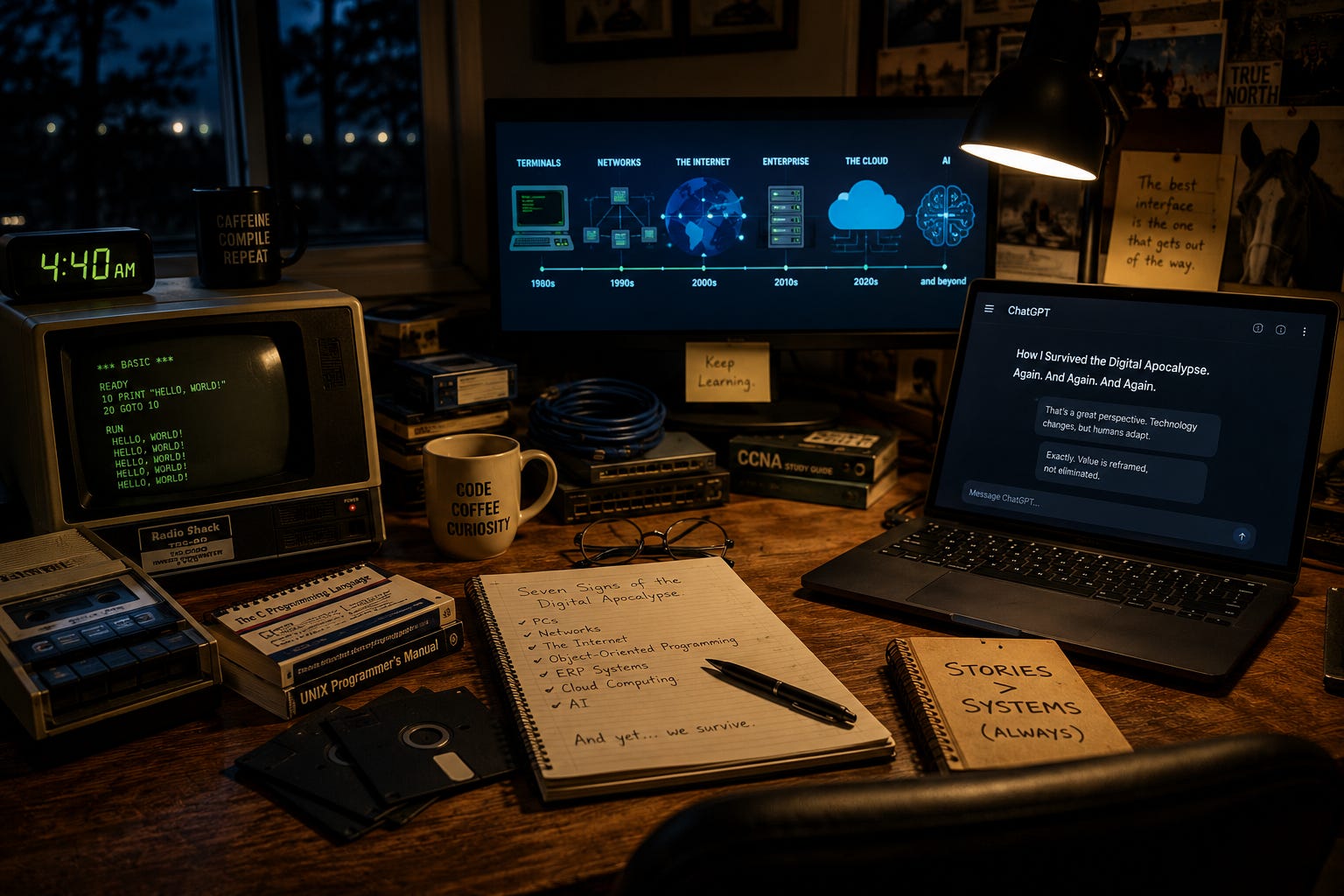
That trip through the future got me thinking about the past, which made me think about my career in tech, which made me think about all of the programming languages I have used. Yeah, 4:40 am, and I’m counting programming languages on my fingers. Welcome to the final third of a human life.
Eighteen, by the way. Eighteen programming languages, beginning on a Radio Shack TRS-80 Model 1: 4k RAM, no HD, cassette tape storage, BASIC programming, monochrome tube monitor that took 60 seconds to warm up. That little box shifted my career trajectory from marine biology to computer science. I swapped potential scars from shark attacks to carpal tunnel and blue-filtered glasses. Sexy, I know. Enjoy that envy.
The next cognitive hop took me through the digital universe, and all the places where my fingers had filled screens with code, or whiteboards with designs, millions of mouse clicks, dozens of certifications, and nearly a million miles of travel as a consultant. And how, now, I spend part of each day interacting with AI, the penultimate enemy of humanity, at least according to science-fiction books, Hollywood, and the current panic flowing through the blogosphere. I say “penultimate” because there always seems to be a next one. It’s the end of the world as we know it… again.
During my morning routine, bouncing between ADHD and OCD, I counted seven technology events that were absolutely certain to destroy civilization. There might have been more, but after a while, they begin to blur together. So, I fired up my little box, about the size of the tape drive on that old Tandy machine, but with more computing power than a space shuttle, and began typing.
So here are my thoughts on the seven signs of the digital apocalypse.
· Personal computers threatened to upend centralized computing and put dangerous power into the hands of everyday employees. (A personal what?)
· Local networks risked exposing critical systems to catastrophic failure. (Does anyone remember Token Ring?)
· The internet threatened to collapse commerce, wipe out privacy, and cultivate global criminal empires. (NSFW!)
· Object-oriented programming was poised to make software overly complex and hard to maintain. (We need more coders!)
· ERP systems could erode business flexibility. (It’s a mainframe with colors!)
· Cloud computing risked undermining internal IT. (What’s a cloud?)
· And now artificial intelligence seems ready to consume human creativity, jobs, and perhaps even consciousness itself before lunch on Thursday. (The Matrix was a biography written by a time traveler!)
Every generation gets its apocalypse.
I have watched these cycles for over forty years, beginning in rooms filled with green-screen terminals and people who spoke in a dialect that 99.99% of the rest of the world had never heard before—bits, bytes, flops, and baud. Back then, systems were expensive, centralized, and heavily controlled. Access itself was a mark of influence. Only important people had terminals. Everyone else had forms and, if they were lucky, adding machines.
Then came the PC.
Suddenly, computing escaped the glass rooms and landed on the desk. We had to move our coffee mugs and family photos, and bribe someone in the facilities department to get a power strip. This terrified people. Not metaphorically. It actually terrified them. Entire management structures had been built around controlling access to information and technology. The PC democratized both overnight. Bookkeepers discovered Visicalc. Typists discovered EasyWriter. Floppy disks were swapped. Sandwiches were warmed over the CPU case. Mass hysteria!
And yet the world survived.
Then networking arrived. LANs. WANs. Modems screaming into the void at 1400 baud while praying nobody picked up the phone in the other room. Suddenly, systems could talk to one another. Data could move between buildings, cities, and eventually countries. This, too, was treated as the beginning of the end.
Hackers would destroy civilization. Hollywood agreed. WarGames taught us that a teenager could potentially trigger nuclear war from his bedroom. Hackers transformed cybercrime into digital punk rebellion, and Swordfish gave us elite techno-criminals manipulating global systems with style, confidence, and apparently unlimited bandwidth. Who was safe? Nobody! Nobody was safe!
And ok, some of that fear was justified. There have always been bad actors. Every technology creates new opportunities for exploitation. But what fascinates me is the consistency of the response. We created encryption schemes and Caller ID. New products and industries to address the threats. And, like we tend to do with everything else, we treated the symptoms, not the disease. But… we survived.
Then the internet went mainstream. This is it! This is The Matrix!
With it came antivirus software, firewalls, intrusion detection systems, identity management platforms, cybersecurity frameworks, compliance departments, cyber insurance, and entire corporate empires dedicated to protecting increasingly complex systems from increasingly sophisticated attacks. These things aren’t inherently bad. Most are really good ideas, and many are kind of necessary. They do, however, point out that we have a habit of layering complexity on top of complexity rather than asking whether the underlying system should be simpler, healthier, or fundamentally redesigned.
Technology often mirrors the American healthcare system that way. Band-aids are quicker than stitches, which are quicker than surgery. We became extraordinarily skilled at managing chronic conditions while struggling to address root causes. Here’s your symptom—here’s your pill. (Warning: Don’t take it if you are allergic to it.)
I saw the same thing happen with enterprise software.
ERP systems promised native integration and efficiency. In many ways, they delivered both. You don’t need to move data between disparate systems. It’s all in the same box, and it’s only going to cost $11 million to implement across your enterprise. And yes, it will make all mainframes and minicomputers obsolete, but because it’s based on new programming languages and modern DBMS, that Y2K problem you don’t know if you have, well, you won’t have it now, even if you didn’t have it in the first place.
These systems also created sprawling ecosystems of customization, consulting, middleware, governance committees, integration platforms, and process workarounds designed to compensate for the reality that businesses are made of humans, and humans stubbornly refuse to operate like computers. And it enabled people like me to travel the world to figure out why the ERP implementation project was overdue and over budget. (Premier 1K status on United by August every year!) But again, humanity survived.
Then came SaaS and cloud computing, and with it, more panic.
Companies would never trust their data to remote providers. Security would collapse. Internal IT would be absorbed into the maintenance department. Everything would become dependent on unstable vendors and dicey internet connections. What do you mean by “work from home?” When do I get to clock out? Now, most organizations operate dozens, sometimes hundreds, of cloud platforms simultaneously while arguing over which collaboration tool should host the meeting to discuss the spreadsheet that tracks the migration roadmap for the next collaboration tool.
And somehow civilization continued, although maybe the definition of “civilization” has morphed a little. Maybe a lot.
Now we arrive at AI.
There’s a lot with this one. Not just jobs, but also environmental impacts, energy consumption, and the potential for abuse by the people who influence the learning models. But we’ve faced similar challenges before. Robots on assembly lines, chlorofluorocarbons killing the ozone layer, coal-burning power plants poisoning communities, and financial influence over regulatory endeavors—same fears, different sources. And what did we do? We took action to survive.
Now, I understand the fear, and I do not dismiss the concerns related to employment. AI will absolutely reshape us. Some jobs will disappear. Others will transform. Entire categories of work will shift toward higher levels of judgment, synthesis, empathy, creativity, and systems thinking, while repetitive cognitive labor becomes increasingly automated. And new roles will rise to meet the new challenges just as they did with other technologies.
But I have seen this movie before. This is what every futuristic Hollywood film warned us about. Thinking machines. Because Hollywood knows: it’s only science fiction until it becomes science fact. But we have been programmed (irony!) to expect Ultron, even if we’re kind of at the WALL-E stage right now.
The people most convinced that the world is ending are often the people whose professional identity was built around the previous system. It’s human nature. It’s what makes people wake up at 4:40 am and ask, “What next?”
Every major technological shift redistributes human value. It changes what society rewards. It changes which skills matter. It changes which assumptions remain reasonable. That process is uncomfortable, especially for people who spent years becoming experts in the old model. (Speaking from personal experience.)
But history, as I hope I pointed out by now, suggests something worth considering: humans panic faster than we adapt—but we adapt. We always have. We always will.
The COBOL programmers who feared object-oriented programming eventually learned classes and inheritance. The administrators who distrusted PCs became network architects. The companies that at first rejected the internet built their corporate websites and probably an online marketplace for their products. The organizations that feared cloud computing now hold strategy meetings in browsers while their employees work from kitchen tables. (Collared shirts required—pants optional, provided you don’t stand up while on camera.)
The work changes. Humans adapt. Value is reframed, not eliminated.
What experience has taught me is that survival during technological revolutions rarely belongs to the people emotionally attached to the previous iteration. It belongs to people who keep learning. The tools change, and we have to change with them. We didn’t get rid of horses just because we started driving cars; we simply adjusted our relationship with them, and we showed them respect by measuring these new machines with a new metric: horsepower.
That lesson has followed me all the way from writing dense APL matrix calculations in college to watching modern AI generate functioning code in seconds. Eighteen programming languages later, I can learn to describe what I need and have the AI create it—sort of. Iteration and revision are still important, as is abstract analysis and creativity, not something AI actually has… yet. (I doubt ChatGPT ever stares out a window and thinks about a story about a girl with a magic piece of chalk.) And after all these years, I find the pattern oddly comforting. As long as I am willing to keep learning, I can keep contributing, just in different ways.
AI isn’t the enemy. It’s a new tool. Every digital apocalypse eventually becomes infrastructure. But all new technologies go through six stages of evolution:
· Mocked
· Feared
· Overhyped
· Badly implemented
· Normalized
· Invisible.
AI is currently dancing between the first three stages. We’re evolving into stage four before we’ve settled stage two, so things are moving quickly. But the terrifying new thing becomes normal. The revolutionary interface becomes boring. The disruptive platform becomes legacy technology. And somewhere a new generation begins warning everyone about the next thing that will surely destroy civilization forever, this time.
They might eventually be right.
For a little while.